



Selling the same inventory on WooCommerce, Amazon, eBay, Etsy or Walmart becomes risky when each channel behaves like a separate store. Stock can oversell, marketplace orders can be missed, and price changes turn into repetitive manual work. The tools below were chosen for bidirectional marketplace operations—listing, inventory and/or order synchronization—not simple product-feed export.
TL;DR
LitCommerce is the strongest broad-marketplace option for most WooCommerce sellers. Salestio is particularly good for Amazon, eBay and Etsy workflows managed from WordPress. Eselt is a useful European-marketplace option, Multichannel for WooCommerce provides a WooCommerce-centered order-management approach, and Sellbrite remains relevant for merchants already using its external multichannel platform.
Quick Comparison
| Plugin | Best for | Pricing |
|---|---|---|
| LitCommerce | broad marketplace coverage | Free entry + paid plans |
| Salestio | Amazon, eBay and Etsy from WooCommerce | Paid service with trial/plan options |
| Eselt | European marketplace synchronization | Service-backed plans |
| Multichannel for WooCommerce | WooCommerce-centered marketplace order management | Commercial WooCommerce extension/service |
| Sellbrite | merchants already using Sellbrite | External service plans |
How I Chose These WooCommerce Multichannel Sync Tools
I required a real marketplace workflow. A plugin had to do more than generate XML or CSV feeds: it needed meaningful synchronization of listings, inventory, prices or marketplace orders. I checked current availability, marketplace coverage, WooCommerce integration and recent maintenance, and compared the category against PluginSuggest’s existing product-feed roundup to avoid cannibalization.
1. LitCommerce — Best for broad marketplace coverage

LitCommerce has one of the strongest WooCommerce footprints in this category, with 2,000+ active WordPress installs when checked. It can connect WooCommerce products and orders with major marketplaces such as Amazon, eBay, Etsy, TikTok Shop and Walmart. The main value is centralized listing and synchronization rather than simply exporting a feed.
Key features
- Connect WooCommerce to multiple major marketplaces
- Bulk-list products to sales channels
- Synchronize inventory across channels
- Synchronize marketplace orders
- Price and listing update workflows
- Supports major marketplaces including Amazon, eBay and Etsy
- Actively maintained WordPress plugin
What I like
The marketplace breadth makes it a practical first shortlist for merchants expanding beyond one channel. It is more aligned with operational multichannel selling than a feed-only plugin.
Limitations
The external service and plan limits matter as your channel and listing counts grow. Complex marketplace category mapping still needs careful setup.
Pricing
A free entry option/plugin is available, with paid LitCommerce plans for larger multichannel usage. Check the current official listing before purchase or deployment.
2. Salestio — Best for Amazon, eBay and Etsy from WooCommerce
Salestio is built specifically around WooCommerce marketplace operations. Its current official documentation describes product export, linking existing listings, order import, stock and price synchronization, fulfillment updates and multiple seller accounts for Amazon, eBay and Etsy. That makes it a strong fit when those three channels are the center of your strategy.
Key features
- Export WooCommerce catalog to marketplaces
- Import marketplace orders into WooCommerce
- Sync stock quantities and prices
- Link existing marketplace listings
- Send fulfillment and tracking updates
- Connect multiple seller accounts
- Supports Amazon, eBay and Etsy
What I like
The workflow is concrete and operational: orders come back to WooCommerce and fulfillment changes can flow outward. That is exactly what separates multichannel sync from a product feed.
Limitations
It is a service-backed integration, so recurring cost and marketplace-specific setup should be budgeted from the start.
Pricing
Salestio is a commercial service with plan-based pricing; verify the current plan for your marketplaces and order volume. Check the current official listing before purchase or deployment.
3. Eselt — Best for European marketplace synchronization
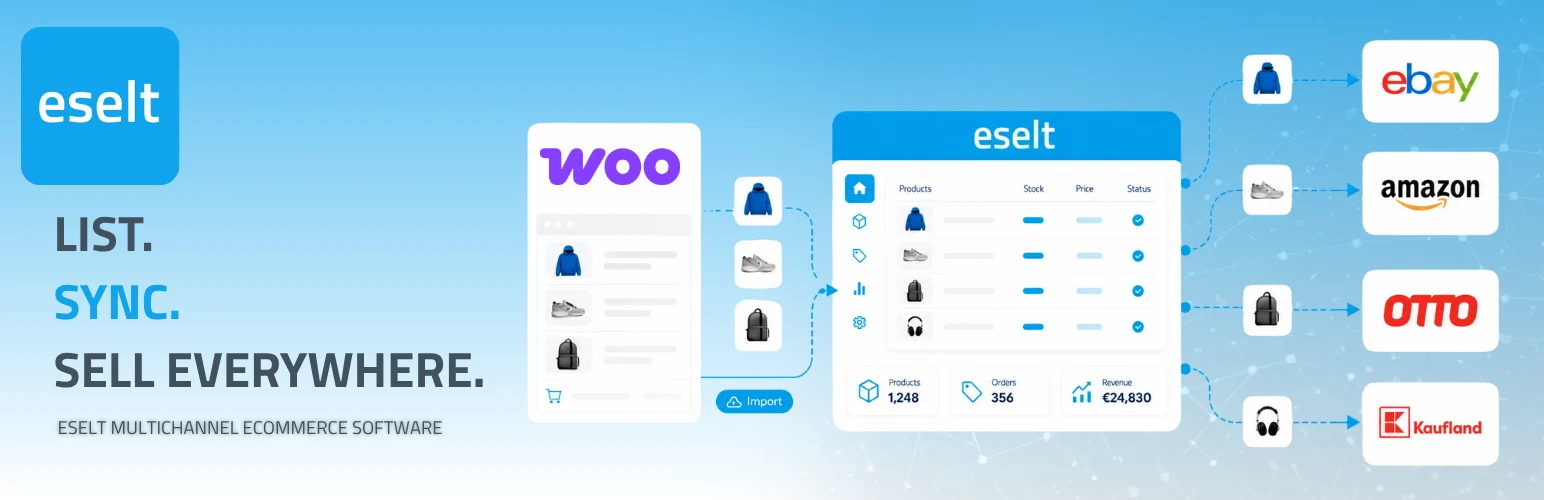
Eselt connects WooCommerce with marketplaces including eBay, Amazon, Kaufland and Otto, with product, stock, price and order synchronization. Its WordPress plugin has a small install base, but it is actively maintained and its European channel coverage gives it a distinct reason to be here.
Key features
- Connect WooCommerce with eBay and Amazon
- Support for European channels such as Kaufland and Otto
- Product listing synchronization
- Real-time stock synchronization
- Price synchronization
- Marketplace order import/management
- Current WordPress.org plugin
What I like
The European marketplace focus is useful for merchants who need more than the usual Amazon/eBay combination.
Limitations
Its WordPress adoption is still small. Verify the exact country-specific marketplace support and plan limits before migrating an established catalog.
Pricing
The connector links to the Eselt service; commercial pricing depends on the current service plan. Check the current official listing before purchase or deployment.
4. Multichannel for WooCommerce — Best for WooCommerce-centered marketplace order management
Multichannel for WooCommerce is designed to use WooCommerce as a central order-management layer. Its documentation covers importing orders from marketplaces including Amazon, eBay, Walmart, Etsy and Overstock, reducing WooCommerce inventory when SKUs match, and sending fulfillment tracking back to connected marketplaces.
Key features
- Import marketplace orders into WooCommerce
- Supports multiple marketplaces including Amazon and eBay
- Inventory reduction based on matching SKUs
- Send tracking and fulfillment data back to marketplaces
- Centralize channel orders in WooCommerce
- Integrates with shipment-tracking workflows
- Current WooCommerce documentation
What I like
It keeps the merchant’s day-to-day order view centered in WooCommerce, which can reduce the number of dashboards staff must monitor.
Limitations
SKU discipline is important, and marketplace catalog/listing capabilities should be checked against your exact channels because order sync alone may not replace a full listing-management platform.
Pricing
This is a commercial/service-backed multichannel solution; verify current WooCommerce marketplace pricing before purchase. Check the current official listing before purchase or deployment.
5. Sellbrite — Best for merchants already using Sellbrite

Sellbrite is an established multichannel platform that connects WooCommerce to a broader external channel-management system. The WordPress connector is not updated as frequently as the newer options in this list, so I would not make it the default for a new store, but it remains relevant for businesses already standardized on Sellbrite.
Key features
- Connect WooCommerce catalog to Sellbrite
- Centralized multichannel inventory workflows
- Marketplace listing management through Sellbrite
- Order synchronization capabilities
- Supports multiple external sales channels
- Useful for existing Sellbrite accounts
What I like
It can make sense when WooCommerce is one channel inside an existing Sellbrite operation rather than the center of the business.
Limitations
The WordPress connector’s update cadence is weaker than the leading choices here. New users should confirm current compatibility and support before committing.
Pricing
Sellbrite is a subscription service; pricing depends on the current plan and sales volume. Check the current official listing before purchase or deployment.
Product Feeds vs True Marketplace Sync
A product feed normally pushes catalog data outward. That is useful for ads, comparison engines and merchant listings, but it does not automatically make WooCommerce and a marketplace operate as one inventory system. A true multichannel selling tool should synchronize operational data in both directions where the channel allows it: listings, stock, prices, orders and fulfillment updates.
This distinction matters most when stock is tight. If Amazon sells the last unit, the useful question is how quickly the tool can reduce availability in WooCommerce, eBay, Etsy or another connected channel. Ask what system is treated as the source of truth, how conflicts are resolved and what happens when a marketplace API is temporarily unavailable.
How the Five Options Differ in Practice
LitCommerce is the broadest fit for sellers who want one system spanning several major marketplaces. Salestio is especially compelling when Amazon, eBay and Etsy are the priority and you want orders flowing back into WooCommerce. Eselt deserves attention from European merchants whose channel mix matches its integrations. Multichannel for WooCommerce is more attractive when the team wants to stay close to the WooCommerce dashboard. Sellbrite makes the most sense when the business already uses Sellbrite or needs a mature standalone multichannel layer.
Before syncing the full catalog, test ten representative products: a simple product, a variable product, an out-of-stock item, a sale-priced item, a product with marketplace-specific attributes and one with multiple images. Confirm how titles, categories, variation values, stock, price changes and orders behave. Marketplace sync problems usually appear in edge cases, not in the clean demo product.
How to Choose a WooCommerce Marketplace Sync Plugin
List the marketplaces you need today and the ones you realistically expect to add within a year. Then test four flows: create or link a listing, change stock in WooCommerce, receive a marketplace order, and send fulfillment/tracking back. A tool that only completes the first step is a feed or listing exporter, not a complete multichannel system.
Pay special attention to SKU matching, variation mapping, marketplace-specific attributes, tax handling and what happens when two channels sell the last unit at nearly the same time. These edge cases determine whether synchronization actually reduces work.
Conclusion
LitCommerce is the broadest starting point for most WooCommerce merchants. Salestio is compelling for Amazon/eBay/Etsy, while regional sellers should compare Eselt’s marketplace coverage. Choose based on bidirectional workflows, not the length of the channel logo list.
Frequently Asked Questions
What is multichannel selling in WooCommerce?
It means selling the same catalog across WooCommerce and external marketplaces while coordinating listings, inventory, prices, orders and fulfillment.
Is a product feed plugin the same as marketplace sync?
No. A feed usually exports product data. Multichannel sync also brings operational data such as orders and stock changes back between systems.
Can multichannel plugins prevent overselling?
Inventory synchronization can reduce overselling risk, but timing, API limits and channel latency still matter. Test low-stock scenarios before launch.
Should WooCommerce be my source of truth?
It can be, but some businesses use an ERP or dedicated multichannel platform as the master catalog. Decide that architecture before configuring sync rules.
This article intentionally differs from our WooCommerce product feed plugins roundup, which covers feed generation rather than bidirectional marketplace operations.

