
Freemium
YITH WooCommerce Wishlist lets shoppers save products, preserve selected variations, and revisit or share favorite items later.
YITH WooCommerce Wishlist combines a free save-for-later plugin with a Premium layer for multiple lists, marketing campaigns, analytics and advanced customer controls. The alternatives below range from similarly mature wishlist suites to leaner low-cost options.
TI WooCommerce Wishlist is the closest marketing-oriented replacement with multiple wishlists, analytics and promotional features in Premium. WPC Smart Wishlist for WooCommerce uses a lower-cost licensing model and a simpler wishlist focus. WCBoost Wishlist keeps the workflow lightweight for stores that mainly need save-for-later behavior. WishSuite – Wishlist for WooCommerce is a free-first HasThemes option with storefront controls. YITH still fits stores that actively use wishlist analytics, multiple lists and automated promotional workflows.
Pricing checked: September 26, 2026.
| Compare | 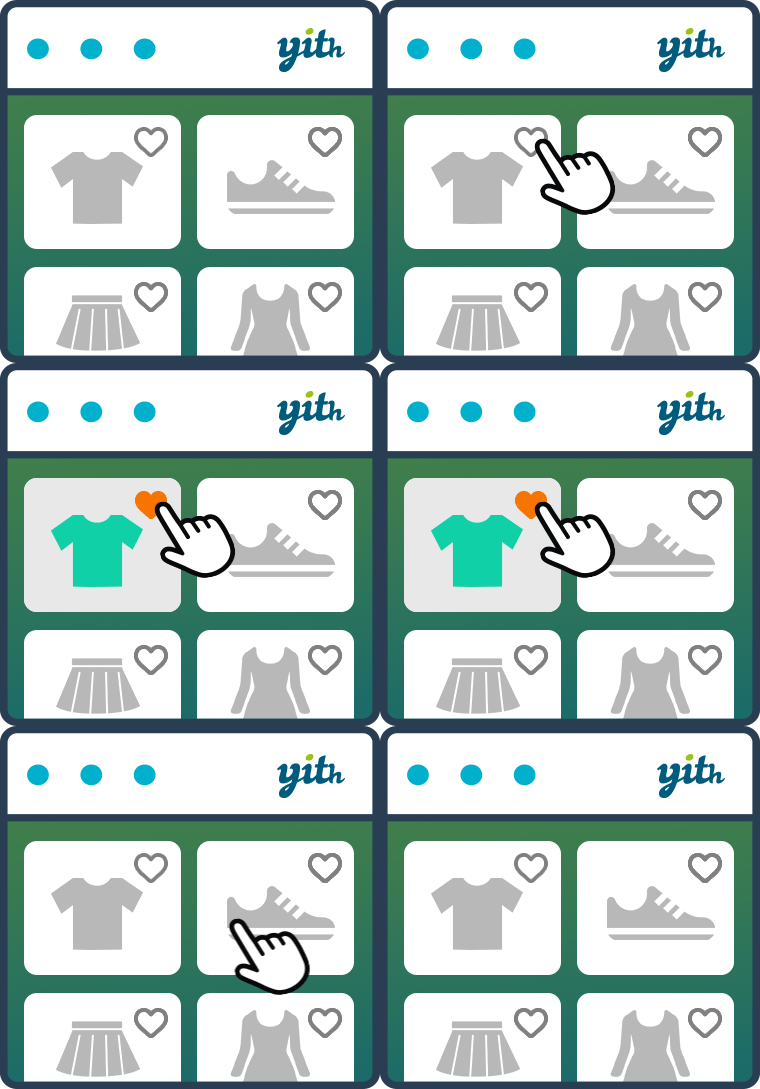 YITH WooCommerce WishlistFree; Premium annual license available |  TI WooCommerce WishlistFree; Premium from $79 |  WPC Smart Wishlist for WooCommerceFree; Premium from $29 for 1 site |  WCBoost WishlistFree; premium annual and lifetime licenses available from WCBoost |  WishSuite – Wishlist for WooCommerceFree; Pro available |
|---|---|---|---|---|---|
| Pricing model | Freemium | Freemium | Freemium | Freemium | Freemium |
| Starting price | Free; Premium annual license available | Free; Premium from $79 | Free; Premium from $29 for 1 site | Free; premium annual and lifetime licenses available from WCBoost | Free; Pro available |
| Free version | Yes | Yes | Yes | Yes | Yes |
| Setup level | Beginner-friendly | Beginner-friendly | Beginner-friendly | Beginner-friendly | Beginner-friendly |
| WordPress.org rating | 3.9/5 (262) | 4.7/5 (501) | 4.8/5 (34) | Not available | 5.0/5 (11) |
| Active installs | 400K+ | 100K+ | 100K+ | 40K+ | 1K+ |
| Best for | WooCommerce stores where shoppers compare products over time, buy gifts, or benefit from saving items before purchase. | WooCommerce stores that want a mature free wishlist with an upgrade path for multiple lists, analytics and promotional workflows | WooCommerce stores that want a lightweight wishlist with low-cost premium licensing and optional multiple lists | WooCommerce stores that want a modern lightweight wishlist with a strong free foundation | WooCommerce stores that want a free-first wishlist from the HasThemes ecosystem with styling and placement controls |
| Not ideal for | Simple stores with a tiny catalog where a wishlist adds little value to the buying journey. | the store only needs a minimal single wishlist and wants the smallest possible extension footprint | the store needs deep wishlist analytics, campaign automation or enterprise-level merchandising workflows | the store requires advanced wishlist-driven email campaigns, quotes, or deep customer analytics | the store needs sophisticated wishlist analytics or campaign automation as a core revenue workflow |
| Tested version | 4.18.1 | 2.12.1 | 6.1.0 | 1.3.1 | 1.5.10 |
| Last reviewed | 2026-09-26 | 2026-09-26 | 2026-09-26 | 2026-09-26 | 2026-09-26 |
| Features |
YITH WooCommerce Wishlist supports saved products, guest and member lists, sharing, multiple wishlists, list privacy, marketing analytics and Premium promotional workflows.
Stores usually compare alternatives because they want a different balance between marketing depth, simplicity, licensing cost and the amount of customer state stored by the wishlist system.
Wishlist plugins also need to work with variations, AJAX product loops, caching, account pages and mobile layouts, so feature lists do not tell the whole story.
TI WooCommerce Wishlist offers a strong free core and a $79 Premium upgrade with multiple wishlists, privacy controls, analytics, promotional email tools and deeper list management.
The Premium model is comparable to YITH because the wishlist can become a marketing data source rather than only a bookmark list. Broad integration coverage is also relevant on stores with many WooCommerce extensions.
TI WooCommerce Wishlist needs the same consent discipline as any marketing-oriented wishlist because saving a product is not automatically permission for promotional email.
Its larger settings surface is unnecessary on very small catalogs that only need one simple wishlist.
WPC Smart Wishlist for WooCommerce provides a free wishlist and currently lists Premium from $29 for one site, including support for multiple wishlists.
The lower license cost can matter for small stores or agencies that need wishlist functionality across several sites without paying for a larger marketing suite.
WPC Smart Wishlist for WooCommerce focuses more on the core save, manage and share workflow than on deep promotional automation.
Stores expecting sophisticated wishlist campaigns or detailed merchandising analytics may want a broader product.
WCBoost Wishlist focuses on a modern wishlist experience without making the wishlist a large marketing system.
That narrower approach can reduce settings and operational overhead on stores where the primary goal is simply helping shoppers return to products later.
WCBoost Wishlist still requires careful cache and session testing because guest and member wishlists are personalized data inside otherwise cacheable product pages.
The lighter model offers fewer marketing-oriented extras than YITH or TI Premium.
WishSuite – Wishlist for WooCommerce adds save-for-later behavior, button controls and a dedicated wishlist workflow with an optional commercial path.
It is relevant for stores already using HasThemes products or teams that want a straightforward wishlist without committing to a feature-heavy Premium suite immediately.
WishSuite – Wishlist for WooCommerce should be tested across product loops, account navigation and variation selections so the saved item state remains clear.
Marketing analytics and sophisticated multi-list workflows are not its primary positioning.
Decide whether the wishlist is mainly a customer convenience feature or an active retention and merchandising channel.
That distinction prevents paying for campaign features the store will never use, or choosing a minimal plugin when the marketing team actually needs list analytics and automation.
A wishlist looks simple, but it stores personalized product intent. Decide how guest lists are persisted, how they merge after login, how long inactive lists are retained, and whether customers can create public or private lists. If the plugin supports promotional email, separate wishlist activity from marketing consent. Saving a product should not automatically be treated as permission to send campaigns.
Variable products deserve special attention. When a shopper saves a shirt, subscription, or configurable item, the wishlist should preserve the selected variation when appropriate. Returning a customer to the generic parent product can add enough friction to make the saved item less useful.
Wishlist actions can appear on category pages, search results, recommendation carousels, quick-view modals, and account pages. Test all of those interfaces with the production cache and CDN stack. Personalized wishlist state must stay tied to the correct shopper without forcing every catalog page to become uncacheable.
Large catalogs should also define how unavailable items are handled. Out-of-stock, private, deleted, or discontinued products need a predictable state so old wishlists do not become collections of broken links. For imported catalogs, include wishlist integrity in product-ID and variation-ID QA.
If the chosen plugin exposes wishlist analytics, use that information as a merchandising signal rather than an automatic campaign trigger. A frequently saved product may indicate price sensitivity, seasonal intent, availability problems, or a long research cycle. Compare wishlist activity with conversion, stock, and margin data before changing promotions.
Multiple wishlists can also change the product experience. Gift lists, project lists, and purchase-stage lists can be useful, but too many options create account clutter. Keep the naming and default-list behavior simple enough that a shopper can save an item without first managing a filing system.
Wishlist migrations are customer-data migrations, even when the data looks simple.
Keep the old wishlist available during validation if possible so frequent customers do not lose saved products without warning.
Before switching wishlist plugins, identify whether the current data lives in user meta, custom tables, cookies, or a mix of storage methods. Logged-in lists may be exportable while guest lists remain browser-specific. That difference determines whether the migration can be invisible or whether some shoppers will effectively start over.
Wishlist privacy settings also need a deliberate mapping. Private, shared-link, and public lists should not accidentally change visibility during import. If the destination plugin supports fewer privacy modes, choose the safest default and explain the change to affected customers instead of silently exposing or hiding lists.
For a large customer base, sample migrated records before launch. Check users with one item, many items, multiple lists, unavailable products, variations, and shared lists. Compare counts and ownership rather than only confirming that the import process completed.
Finally, decide how wishlist data fits the site privacy policy and deletion workflow. If customers request account erasure, saved-product data should follow the same lifecycle rules as other account-linked data rather than remaining indefinitely in a plugin table.
YITH remains a strong fit when the store uses multiple wishlists, wishlist analytics, price tracking, back-in-stock or sale notifications, and targeted promotional campaigns.
If those workflows are already integrated with merchandising and customer communication, replacing YITH simply to reduce settings can create more migration cost than operational benefit.
Also verify that wishlist counts and customer account links update correctly after login so shoppers do not see stale guest-state data.
TI WooCommerce Wishlist, WPC Smart Wishlist, WCBoost Wishlist and WishSuite are direct WooCommerce wishlist alternatives.
TI Premium and WPC Smart Wishlist Premium both support multiple wishlist workflows.
WPC Smart Wishlist currently lists Premium from $29 for one site.
It depends on the plugins involved. Verify export or import support before switching, especially for logged-in customer lists.
They can if personalized list state is cached incorrectly. Test guest and logged-in actions with the production cache stack.
Staying makes sense when its Premium analytics, multiple lists and automated marketing workflows are already part of the store strategy.
YITH WooCommerce Wishlist lets shoppers save products, preserve selected variations, and revisit or share favorite items later.
TI WooCommerce Wishlist adds customer wishlists to WooCommerce with a substantial free feature set and a Premium tier for multiple…
WPC Smart Wishlist for WooCommerce provides a compact wishlist workflow for WooCommerce and uses a lower-priced premium model than many…
WCBoost Wishlist adds a modern wishlist flow to WooCommerce so shoppers can save products, return later and manage purchase intent…
WishSuite – Wishlist for WooCommerce adds wishlist functionality to WooCommerce with a free-first model and close alignment with other HasThemes…