


A brand font can make a site feel distinctive, but adding it badly can create layout shifts, privacy issues, or a mess of CSS overrides. The right WordPress custom font plugin should make font files easy to manage, let you assign typography without editing theme files, and avoid unnecessary external requests. This roundup focuses on font upload, self-hosting, and practical typography control rather than icon fonts or page-builder-only styling.
TL;DR
Custom Fonts is the best free-first choice for self-hosting brand fonts and Google Fonts. Use Any Font is strong when you want automatic conversion and broad theme/builder compatibility. Fonts Plugin is better for users who want Google Fonts, Adobe Fonts, uploads, and live visual controls in one place. OMGF is the specialist pick when the main problem is localizing Google Fonts for privacy and performance.
Quick Comparison
| Plugin | Best for | Pricing |
|---|---|---|
| Custom Fonts | Free local hosting for brand fonts and Google Fonts | Free |
| Use Any Font | Uploading licensed fonts with automatic web-font conversion | Free/freemium |
| Fonts Plugin | Visual typography control across Google, Adobe and uploaded fonts | Free + one-time Pro |
| OMGF | Localizing existing Google Fonts for privacy and speed | Free + Pro |
How I Chose These WordPress custom font plugins
I prioritized plugins that still solve a real 2026 typography problem: uploading or self-hosting fonts, assigning them reliably, handling common font formats, and working across modern WordPress themes or builders. I also separated typography plugins from general page builders because PluginSuggest already covers page builders as their own buying decision.
1. Custom Fonts — Best for Free local hosting for brand fonts and Google Fonts

Custom Fonts — Custom Fonts by Brainstorm Force is the easiest recommendation when you mainly need to upload font files or host Google Fonts on your own server. It supports multiple font variants and integrates with Full Site Editing, Astra, Spectra and Elementor without forcing you into a separate typography system.
Best For
Free local hosting for brand fonts and Google Fonts.
Key Features
- Upload TTF and OTF font files
- Host selected Google Fonts locally
- Manage multiple weights and styles
- Use fonts with Full Site Editing themes
- Works with Astra, Spectra and Elementor
- Local hosting reduces third-party font requests
Pros
Completely free, widely used, and focused on the core job without adding a large design framework.
Cons
It is more of a font-management layer than a full typography design suite, so detailed per-selector controls still depend on your theme or builder.
Pricing
Custom Fonts is completely free on WordPress.org. There is no separate Pro plan or paid upgrade for the plugin.
2. Use Any Font — Best for Uploading licensed fonts with automatic web-font conversion
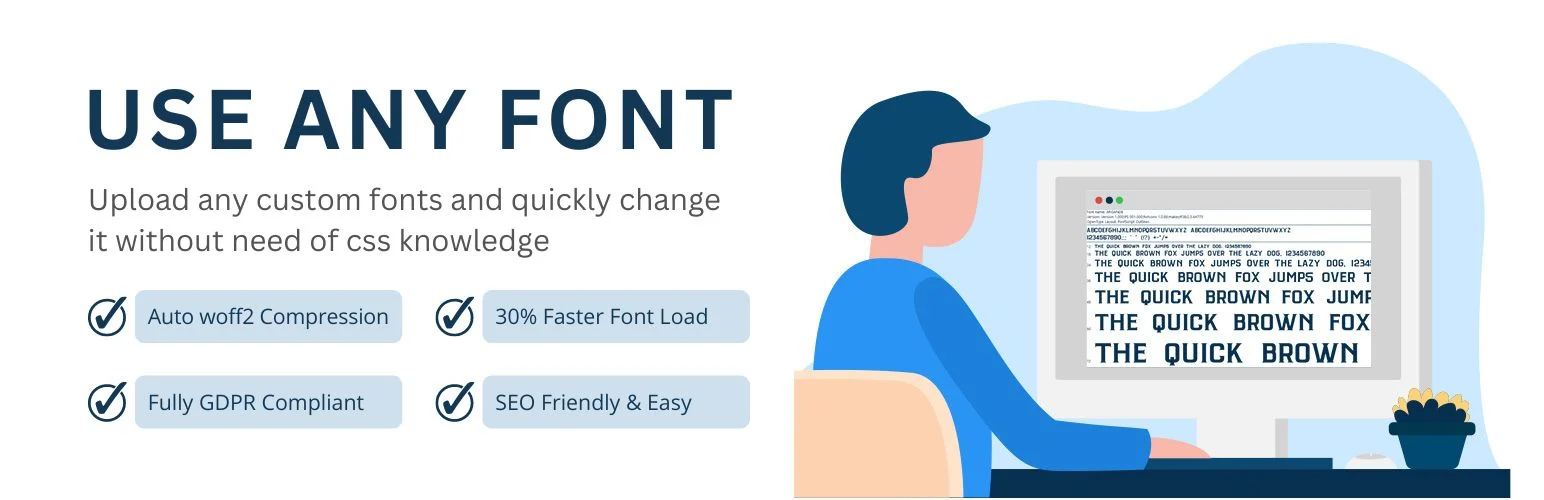
Use Any Font — Use Any Font is a long-running option for site owners who have desktop font files and want them converted and applied without writing @font-face rules manually. Its value is convenience: upload, convert, then assign fonts to common elements or custom selectors.
Best For
Uploading licensed fonts with automatic web-font conversion.
Key Features
- Upload custom font files from WordPress
- Automatic WOFF2 conversion for web use
- Self-hosted font delivery
- Assign fonts to headings, body and other elements
- Supports custom CSS selectors
- Works with many themes and page builders
Pros
Very approachable for non-developers and useful when the font you received is not already in web-ready format.
Cons
Some workflows depend on its conversion/service model, so privacy-sensitive or fully offline setups may prefer a plugin that only uses local processing.
Pricing
Use Any Font offers a free Lite/Test API key that supports a single font conversion. Paid API keys are available for additional font use, but the current public site does not list a fixed license price.
3. Fonts Plugin — Best for Visual typography control across Google, Adobe and uploaded fonts

Fonts Plugin — Fonts Plugin goes beyond simple upload support. It combines Google Fonts, Adobe Fonts and custom uploads with a live preview, making it a better fit when you want to experiment with typography rather than simply register one brand typeface.
Best For
Visual typography control across Google, Adobe and uploaded fonts.
Key Features
- 1,400+ Google Fonts in the free version
- Adobe Fonts integration
- Upload TTF, OTF, WOFF and WOFF2
- Live Customizer preview
- Heading and body font assignments
- Pro local hosting and selective font loading
- Pro per-element typography controls
Pros
One of the broadest font-source choices and a friendly visual workflow.
Cons
The most useful performance controls, including local Google Font hosting and selective loading, sit in Pro.
Pricing
Fonts Plugin has a free version. Pro is a one-time purchase: $58 for 1 site, $98 for 3 sites, or $198 for 10 sites, with lifetime updates and no renewal fee.
4. OMGF — Best for Localizing existing Google Fonts for privacy and speed

OMGF — OMGF solves a narrower but important problem: a theme or plugin is already loading Google Fonts remotely and you want to host those files locally. It is not the best choice for designing a typography system from scratch, but it is excellent for cleaning up existing font delivery.
Best For
Localizing existing Google Fonts for privacy and speed.
Key Features
- Detect Google Fonts used on the site
- Download and serve font files locally
- Reduce external Google font requests
- Improve privacy control
- Preload selected font files
- Advanced font-loading controls in Pro
Pros
Purpose-built for privacy and font-delivery cleanup, with a large install base.
Cons
Less useful if your main need is uploading a proprietary brand font and visually assigning it across the site.
Pricing
OMGF is free on WordPress.org. OMGF Pro is a paid add-on that includes 1 year of updates and support; the vendor currently shows the license price during purchase rather than as a stable public figure on the product page.
How to Choose the Right WordPress custom font plugins
Choose based on the bottleneck. If you already own font files, start with Custom Fonts or Use Any Font. If you want to browse and preview Google or Adobe fonts while changing typography, Fonts Plugin is more convenient. If your design is already finished and the problem is remote Google Fonts, OMGF is the cleaner tool. Whatever you choose, avoid loading every available weight; three or four carefully chosen variants are usually enough for a production site.
For broader design control, compare our best WordPress page builders. If speed is the reason you are revisiting fonts, the image optimization roundup covers another common front-end bottleneck.
What Matters Most When Adding Custom Fonts
Font choice is only half of the job. The delivery method affects Core Web Vitals, privacy, and how reliably the typeface renders in the editor and on the front end. A font plugin should let you control the exact weights you load. If a family includes nine weights but your design only uses 400, 600 and 700, loading the rest adds requests and bytes with no visual benefit. Variable fonts can reduce file count, but theme and browser behavior still needs testing.
Also check licensing before uploading commercial fonts. Buying a desktop license does not always include web embedding rights. The plugin cannot solve a licensing problem, so confirm that your font license permits self-hosting on the website. For multilingual sites, verify that the font includes the character sets your content needs; otherwise visitors may see inconsistent fallback fonts.
Custom Fonts vs Google Fonts vs Adobe Fonts
Use a custom uploaded font when brand consistency matters and you already have the licensed files. Google Fonts are easier when you want a broad free library, but local hosting is preferable when privacy or external requests are a concern. Adobe Fonts can be convenient for Creative Cloud customers, but it remains a service dependency rather than a fully self-hosted asset. The best WordPress typography plugin is therefore the one that matches the source of your fonts, not simply the plugin with the most controls.
Performance Checklist for WordPress Typography
- Prefer WOFF2 where available and keep only the weights you actually use.
- Preload only fonts needed above the fold; preloading every font can make performance worse.
- Use a sensible font-display strategy so text remains readable while fonts load.
- Test headings, body text, forms, WooCommerce elements and the block editor after changing font assignments.
- Clear page/CDN caches after replacing a font file because old font URLs can remain cached.
Which Type of Site Needs a Dedicated Font Plugin?
A small blog using one system font may not need any font plugin at all. A dedicated tool becomes useful when a brand requires licensed typefaces, when a multilingual site needs careful weight and character-set control, or when a theme loads fonts from a service you want to replace. Agencies also benefit from centralizing font registration so editors do not have to repeat CSS snippets across templates.
Page-builder users should first check what their builder already provides. Elementor, Breakdance, Divi and others have their own typography controls. Installing a second typography layer can create competing CSS rules. In that setup, use a plugin mainly for font registration or local hosting and let the builder remain the source of truth for sizes, line heights and element assignments.
For a block theme, the WordPress Font Library may cover more cases than it did a few years ago. The plugins in this roundup still matter when you need formats, local-hosting behavior, conversion, Adobe integration, or compatibility outside the Site Editor. The simplest stable stack is usually one font-management tool plus one design system, not several overlapping typography plugins.
Conclusion
The best WordPress custom font plugins depend on the workflow you are trying to simplify, not the longest feature list. Use the comparison above to narrow the field, verify the current vendor documentation, and test the most important workflow on staging before making it part of a production site.
Frequently Asked Questions
Do I need a plugin to use custom fonts in WordPress?
Not always. Block themes and page builders can handle some font workflows natively, but a dedicated plugin is useful when you need self-hosted files, broader format support, conversion, or centralized management.
Is self-hosting Google Fonts better?
It can reduce third-party requests and give you more privacy control. Performance still depends on file size, caching, and how many weights you load.
Which font format is best for WordPress?
WOFF2 is generally the preferred web format because it is compact and well supported. Keep fallback formats only when your audience or tooling requires them.
Can custom fonts slow down WordPress?
Yes. Loading too many families, weights, or large files can delay text rendering. Use only the variants your design actually needs.
Practical Setup Checklist
- Back up the site before installing a plugin that changes content or media behavior.
- Test the core workflow on staging with real content, not only demo data.
- Check mobile behavior and keyboard accessibility on the public front end.
- Review plugin update history, support activity and export options before committing.
- Document any paid add-ons or external services the workflow depends on.

