



A WordPress review plugin can mean several different things. One site needs customers to leave reviews directly on a service page. Another wants to display Google Business reviews. A WooCommerce store needs product ratings and reminder emails. A local business may care more about asking happy customers for public reviews than storing reviews in WordPress.
I would choose the review workflow before choosing the plugin. Mixing imported Google reviews, on-site testimonials, WooCommerce product ratings, and review-generation funnels into one category makes feature comparisons misleading.
These five tools represent the main review models in 2026. For broader ecommerce functionality, compare our WooCommerce plugins. If structured review markup is part of the SEO plan, also see our WordPress schema plugins and follow Google’s eligibility rules rather than adding review schema everywhere.
TL;DR
- Site Reviews: best overall for collecting, moderating, assigning, and displaying first-party reviews directly inside WordPress.
- Widgets for Google Reviews by Trustindex: best for displaying external Google Business reviews in polished widgets without building a full on-site review system.
- ReviewX: best for WooCommerce stores that want multi-criteria product reviews, media, reminders, and richer product-rating workflows.
- Customer Reviews for WooCommerce: best for automated post-purchase review reminders, verified-review workflows, Q&A, and review-for-discount campaigns.
- Starfish Reviews: best for businesses that want review-generation funnels and private feedback before sending customers to Google, Facebook, or another review platform.
Quick Comparison
| Plugin | Best for | Review source | Pricing |
|---|---|---|---|
| Site Reviews | First-party WordPress reviews | Collected on your site | Free + premium add-ons |
| Trustindex Google Reviews | Displaying Google reviews | Google Business/external platforms | Free option; paid from $65/year |
| ReviewX | WooCommerce multi-criteria reviews | Product customers | Free + Pro |
| Customer Reviews for WooCommerce | Review reminders and verified reviews | WooCommerce customers | Free + Pro/service options |
| Starfish Reviews | Review generation campaigns | Customers sent to chosen platforms | Free + premium |
How I Chose These Plugins
I compared how each plugin collects or imports reviews, moderation, WooCommerce support, media reviews, reminders, widgets, review-generation workflows, data ownership, structured output, and active maintenance. Current product information and public pricing were checked in September 2026.
1. Site Reviews – Best Overall First-Party Review Plugin

Site Reviews is my first choice when the reviews should actually belong to the WordPress site. It lets visitors submit reviews, administrators moderate them, and editors assign reviews to posts, pages, users, products, or other content depending on the setup.
The plugin feels more like a native review system than a Google-review widget. That makes it useful for directories, service businesses, product sites, membership communities, and custom post types where reviews are part of the site’s own content model.
Key features
- Front-end review submission forms
- Review moderation and approval
- Assign reviews to posts, pages, users, and supported content
- Rating summaries and review displays
- WooCommerce and SureCart integrations
- Premium add-ons for advanced review workflows
Pros: Strong free core, flexible WordPress-native data model, active maintenance, and better ownership than relying entirely on an external review platform.
Cons: More configuration than a simple Google-review widget and can feel developer-oriented for advanced setups.
Best for: Service sites, directories, communities, and custom WordPress projects that need first-party reviews stored on the site.
Pricing: Free core plugin. Gemini Labs offers premium add-ons and commercial features for advanced use cases.
2. Widgets for Google Reviews by Trustindex – Best for Displaying External Reviews

Widgets for Google Reviews by Trustindex is designed around social proof that already exists elsewhere. Instead of asking visitors to leave reviews in WordPress, it imports or displays reviews from Google and other supported review platforms through customizable widgets.
I would use this model when Google Business reviews are the source of truth and the website only needs to showcase them. That avoids maintaining two separate review databases and is especially useful for local businesses, agencies, restaurants, clinics, and service companies.
Key features
- Google review widgets
- Multiple layouts and predesigned styles
- Rating filters and review display controls
- Shortcode and page-builder support
- Support for many external review platforms on paid plans
- Automatic review syncing and advanced widgets in paid packages
Pros: Fast way to reuse real external reviews, polished widgets, and no need to build a first-party review collection system.
Cons: The workflow depends on an external review platform/service and free-versus-paid limits need to be checked carefully.
Best for: Local businesses and service companies whose main reputation already lives on Google or other public review platforms.
Pricing: Free options are available. Trustindex’s current Single paid package starts at $65 per year for one domain.
3. ReviewX – Best for Multi-Criteria WooCommerce Reviews
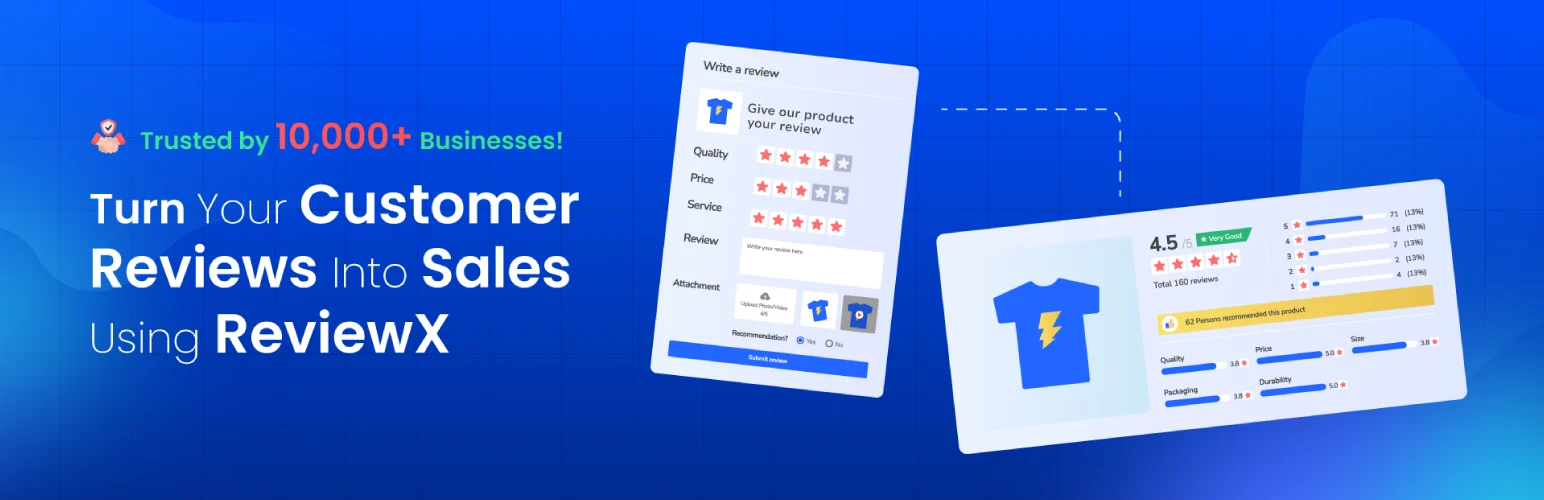
ReviewX is built around richer WooCommerce product reviews. Instead of one overall star rating, stores can add multiple criteria such as quality, value, usability, or delivery experience depending on the product.
The plugin also supports media reviews, review summaries, reminder workflows, discount incentives, and dedicated review blocks. I would choose it when product feedback itself is an important part of merchandising rather than a simple default WooCommerce review tab.
Key features
- Multi-criteria product ratings
- Photo and video review support
- Review reminder workflows
- Discount-for-review options
- Review summary, list, criteria graph, and rating blocks
- Google review and schema-related features depending on setup
Pros: More detailed product feedback than standard WooCommerce reviews and a strong block-based presentation toolkit.
Cons: Some management and automation features are paid, and the richer workflow is unnecessary for stores that only need simple star ratings.
Best for: WooCommerce stores where shoppers benefit from rating several product qualities separately.
Pricing: Free version available, with ReviewX Pro for additional management, reminder, media, and advanced review features.
4. Customer Reviews for WooCommerce – Best for Review Reminders

Customer Reviews for WooCommerce is strongest after the sale. It can automatically ask verified customers for feedback, collect several product reviews through one review form, support images and videos, add Q&A, and offer discount incentives for reviews.
I would choose it when the problem is not displaying reviews but getting more customers to leave them. The reminder workflow closes the gap between order completion and customer feedback without requiring the store owner to send manual emails for every purchase.
Key features
- Automated review reminder emails
- Aggregated review forms for several purchased products
- Photo and video reviews
- Review-for-discount campaigns
- Product Q&A
- Import/export and optional verified-review service
Pros: Strong post-purchase automation, large active store base, and practical tools for generating more product feedback.
Cons: WooCommerce-specific, so it is not the right foundation for service reviews or non-store custom post types.
Best for: WooCommerce stores that want automated review collection after fulfilled orders.
Pricing: Free plugin available. Pro and optional CusRev service features are available separately.
5. Starfish Reviews – Best for Review Generation Funnels

Starfish Reviews focuses on the process of asking for feedback. You create a review funnel, send customers to it, and then guide them toward a chosen public review destination or collect private feedback depending on the response and configuration.
This is useful when the business wants a structured reputation workflow rather than a normal star-rating form under WordPress posts. Premium versions also add review importing, collections, and broader review marketing capabilities.
Key features
- Review-generation funnels
- Send customers to chosen external review destinations
- Collect private customer feedback
- Reusable funnel URLs
- Testimonials and imported review collections in premium versions
- Review marketing workflow for agencies and local businesses
Pros: Clear reputation-management use case and useful for businesses that actively ask customers for feedback.
Cons: It is not a replacement for a complete on-site product review system such as Site Reviews or ReviewX.
Best for: Local businesses, agencies, and service companies running structured review-request campaigns.
Pricing: Free version available, with premium editions for advanced review importing, collections, and marketing features.
Which One Should You Choose?
Choose Site Reviews when WordPress should own the review database. Use Trustindex when external Google reviews are the main source of social proof. ReviewX is the richer WooCommerce product-rating system, Customer Reviews for WooCommerce is stronger for automated post-purchase collection, and Starfish Reviews is built around asking customers for reviews and feedback.
Do not manufacture ratings, import reviews without permission, or mark up reviews in ways that do not match the visible content. Review plugins can improve collection and presentation, but trust comes from authentic feedback and transparent moderation.
Conclusion
Review plugins solve different reputation problems. Site Reviews is the strongest WordPress-native review system, Trustindex is better for displaying external reviews, and ReviewX handles richer WooCommerce ratings. Customer Reviews for WooCommerce focuses on generating more post-purchase feedback, while Starfish Reviews is designed for review-request funnels. Start with where the review should live and how it should be collected, then choose the plugin.
Frequently Asked Questions
What is the best WordPress review plugin?
Site Reviews is the best general-purpose first-party review plugin. ReviewX and Customer Reviews for WooCommerce are better for product-review workflows, while Trustindex is better for displaying Google reviews.
Can I display Google reviews on WordPress?
Yes. Plugins such as Trustindex can display Google Business reviews through widgets and layouts designed for WordPress.
Which review plugin is best for WooCommerce?
ReviewX is strong for multi-criteria product ratings and rich review presentation. Customer Reviews for WooCommerce is stronger when automated review reminders and verified post-purchase feedback are the main goal.
Do review plugins automatically improve SEO?
No. Reviews can improve useful content and trust, but structured review markup must follow search-engine eligibility rules. Adding stars or schema does not guarantee rich results or rankings.
Should I moderate customer reviews?
Yes, for spam, abuse, personal data, and policy violations. Moderation should not mean deleting legitimate negative feedback simply because the rating is low.

